Saturday, November 7, 2009

The Over 50K College Cost Club (Per Year) ... Who's in it?


What do Georgetown, George Washington, and Johns Hopkins have in common? They all cost over $50K per year to attend and they all made it onto the list of the top ten most expensive colleges in America, according to numbers recently compiled by The Chronicle of Higher Education. Two of the three, Georgetown and GW, are perennial favorites having been among the top 20 most expensive colleges since at least 2003.

For the second year in a row, Sarah Lawrence College in New York has the dubious honor of being the most expensive college in the nation with tuition, fees, room and board totaling $55,788. Georgetown ($52,161) comes in at number three, with GW ($51,775) and Johns Hopkins ($51,690) holding the number five and six spots. St. John’s College in Annapolis joined other local $50K Club members at number 42 with costs totaling $50,352 per year.

It’s no secret that the cost of post-secondary education has gone up faster than the prices of other goods and services. Last year, only five private nonprofit colleges and universities in the country could boast of membership in the $50K Club. This year, the list has grown to 58. And the trend shows no signs of slowing down, despite press releases from the National Association of Independent Colleges and Universities (NAICU) announcing that tuition at private colleges rose only 4.3 percent—the smallest increase in 37 years. In fact, it appears that the market can bear much more as many of the nation’s most expensive institutions have seen no drop in demand.

Although generous aid packages mean that most students don't pay sticker price, it’s fair to say college is rapidly becoming a luxury outside the means of middle class families. While aggressive building campaigns and upgrades in other campus amenities may account for a huge hunk of the need for higher revenue, it’s also true that increased need for financial aid among students figures into the equation. It’s a vicious cycle that depends heavily on some students paying full freight while colleges continue to gamble that the economy will improve enough for them to stop dipping into endowments some time before the bottom falls out.


America's Top Ten Most Expensive Colleges and Universities
1.
Sarah Lawrence College, NY
$55,788
2.
Landmark College, VT
$53,900
3.
Georgetown University, DC
$52,161
4.
New York University
$51,993
5.
George Washington University, DC
$51,775
6.
Johns Hopkins University, MD
$51,690
7.
Columbia University, NY
$51,544
8.
Wesleyan University, CT
$51,432
9.
Trinity College, CT
$51,400
10.
Washington University, MO
$51,329

The above information was written by: Nancy Greisemer of College Explorations.

My alma mater, Emory University, also is part of the elite over 50K first year college costs. The 2009 -2010 estimated costs for tuition, room and board, student fees, books, and travel amount to 51K. Although, only 1/3 of students pay the sticker price. Financial Aid and scholarships are key to making these colleges listed affordable.  (Lone Star Ed Consulting, Lauren Kahn, M.A.)

To check the cost of your potential dream college, visit The Chronicle's tuition and cost database. The figures represent charges to first-time, full-time undergraduates based, typically, on a nine-month academic year of 30 semester hours or 45 quarter-hours. An asterisk (*) indicates that an institution provided projected figures for 2009-10. The designation “n/a” indicates that figures were not available.

The data does not reflect the cost of attendance at an institution after grants and other student aid are considered. This net cost is often lower than the published fees shown.

Tip of the Week: (Belated Free Advice Friday) Deadlines still matter: Need-based financial aid is an annual process. Students have to fill out a Renewal Free Application for Federal Student Aid each year, and, if their college uses it, a CSS -Profile form. "Over the years, I've noticed the rising sophomore is the student who tends to be late filing," Mr. Gelinas said. After all, students are only on campus for a few months before they have to apply for aid again. It does not stop after freshman year. Also, know what GPA you need to maintain in order to keep your scholarship.


It is not too late to jump start your college planning process. The information was provided by Lauren Kahn, CEO of Lone Star Ed Consulting. If you would like more information about Lone Star Ed Consulting's college planning services, please e-mail Lauren Kahn or call her at 512-294-6608. You can also view LSEDC's brochure here.

Wednesday, November 4, 2009

"College Week Live" (November 4-7) Ask the College Experts

College Week Live is coming to you. College Week Live is a virtual college fair that features representatives from over 300 colleges and educational consultants.  College Week Live launched in 2007 and has held more than six successful virtual college fairs. During the dates of November 4 – 7, this Wednesday - Saturday, College Week Live will connect students from across the country and the world to the college search and application process without leaving their home, office, or school. I will be a featured guest representative for IECA on November 5th from 5:30PM - 6:30PM (EST) and November 6th from 1 - 2PM (EST). Please register at collegeweeklive.com and log on this week to explore this college educational tool. Among the highlights: the opportunity to speak to representatives of over 300 colleges, the chance to hear keynote presentations via Webcast (including Ted Fiske of Fiske Guide and representatives from the Department of Education, among many others), and the chance to video chat live with college students.
One of the most popular features last spring was the “Counselor-on-Call” chat area where students and parents by the hundreds were able to pose questions to professional counselors. IECA Members will be staffing the counselor-on-call area, and are doing so as volunteers, like myself.  We expect to answer questions ranging from testing, to volunteer service, to financial aid, and much, much more.(Independent Educational Consultants Association).

Texas Universities participating in College Week Live: Texas Tech, University of Houston, Schreiner College, Sam Houston State, and University of North Texas.

Scholarships....
There are promotional prizes that you can win for registering and participating in "College Week Live." Juniors and seniors, tell your English teachers about the virtual college fair. Maybe, they will even allot class time for you to visit the virtual fair.

Upcoming CollegeWeekLive Promotions

College Scholarship: $2,500 CollegeWeekLive Scholarship Contest
Looking for a college scholarship? CollegeWeekLive is proud to help our audience pay for college with the return of our scholarship contest! One student will win a $2,500 college scholarship, good at any accredited institution! To enter the contest:

1.Register for CollegeWeekLive
2.Login/ attend CollegeWeekLive during a live event during the Fall 2009 semester

A lucky attendee will be chosen to receive the $2,500 scholarship. Please see contest details on the Scholarships page. Good luck to all who enter!
For more details on this wonderful event, visit College Week Live.

It is not too late to jump start your college planning process. The information provided was written by Lauren Kahn, CEO of Lone Star Ed Consulting. If you would like more information about Lone Star Ed Consulting's college planning services, please e-mail Lauren Kahn or call her at 512-294-6608. You can also view LSEDC's brochure here.

Friday, October 30, 2009

Ominous Traditions and Superstitions on College Campuses

It is Free Advice Friday! I have two tips to share.

Regarding Early Action / Early Decision Applications:
1) Make sure you get a certified delivery confirmation receipt on any items you send out to the colleges. 2) For electronic submission of your applications, print out the confirmation message. Do not rely on an e-mail confirmation only. Make sure it looks as perfect as possible before you press that SUBMIT button.

Transcripts:
Get a confirmation from your high school registrar's office that your transcripts were sent out by the college's stated deadline. Things can fall through the cracks. True story: My college application never made it to the University of Michigan. Upon my Early Decision acceptance to Emory, I called the U of M's admissions office to withdrawal my application and was informed that they never received my transcript or application and only had my test scores on file. Ouch! (I know this was pre-electronic application time, but you can never be too cautious.)

So, now for some "FUN" information: Ominous Traditions and Superstitions on College Campuses

Duke University: To get free tickets to Duke basketball games, students camp out in tents complete with on-line access so they can continue studying and stay connected. Some unofficial graduation "requirements" decree that before they graduate, students must drive backwards around the traffic circle and climb Baldwin Auditorium. Several of Duke's gothic-style buildings feature gargoyles that are difficult to find. The Duke Chapel is haunted one night every year. (Durham, NC)


Emory University: The unofficial mascot of the university is Dooley, a skeleton figure dressed in black. In the spring during Dooley's Week, he wanders the campus, showing up in classrooms to let students out of class. Back in my day, Dooley's week was during the week of Halloween and the week culminated in a big costume ball the weekend before or after Halloween. It is an honor to be part of Dooley's Entourage. (Atlanta, GA)

Georgetown University: Ever since the film "The Exorcist" was shot in part on the campus, Halloween has been a major holiday at Georgetown. The film is shown after dark on Halloween, either outside on Copley lawn or in Gaston Hall. The film ends around midnight, the hour at which Georgetown students gather in the cemetery on campus for the "Healy Howl." In the cemetery at midnight, in the shadow of Healy Hall, Georgetown students literally howl at the moon. A statue of John Carroll, the founder of Georgetown, is located at the entrance of the campus. Before they graduate, students try to have their photo taken in Carroll's lap. This requires stealthy evasion of the Department of Public Safety patrols trying to end a tradition they believe to be harmful to the statue's longevity. The usual game plan is to leap into John Carroll's lap, have a friend snap the picture, and make a run for it. (Washington, DC)
Princeton University: At the commencement ceremony, new graduates pass through the Fitzrandolph Gates, the main entrance to the campus from Nassau Street, and enter the "real world." According to fairly recent tradition, undergraduates who use the gates to exit the campus before their own commencement put their chances of graduating at risk. (Princeton, NJ)


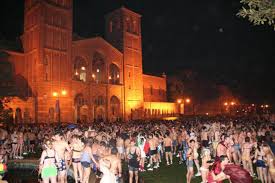
University of California -- Los Angeles: Midnight Yell is held during finals week. The Janss Steps, an 87-step expanse of stairs, served as the original entrance to the university. The land on which the university was built had been owned by the Janss brothers, and it was proposed that a structure be built in their honor. Edwin, the practical younger brother, lobbied for a parking garage, but Hans, the older brother, insisted on something more aesthetic: sloping lawns with majestic steps leading up to the main quad. Suspecting that after he died, his little brother would simply replace the steps with parking, Hans had himself buried under the sixth step. Tradition holds that students must never set foot on the sixth step from the bottom or they will spend an extra quarter (or longer) on campus. Fraternities sometimes hold seances on the step, easily identified by the drippings from their candles. A large statue of the UCLA mascot, the Bruin, stands near the student union. Students rub his right hind paw (the "Bruin Paw") for luck before exams. Before becoming a rock legend, Jim Morrison, lead singer of The Doors, briefly attended UCLA. Tour guides point out a locker in the math building purported to be Morrison's that is still plastered with brightly colored stickers and remains locked. (Los Angeles, CA)
University of Virginia: According to tradition, before they graduate, students must run naked from the Rotunda down the Lawn to the statue of Homer (which must be kissed on the buttocks) and then back to the Rotunda before retrieving their clothes. (Charlottesville, VA)

Ominous Traditions Source: Leads provided by Susan Solomon, Kehillah Jewish High School, Palo Alto, California.

It is not too late to jump start your college planning process. The information provided was written by Lauren Kahn, CEO of Lone Star Ed Consulting. If you would like more information about Lone Star Ed Consulting's college planning services, please e-mail Lauren Kahn or call her at 512-294-6608. You can also view LSEDC's brochure here

Monday, October 26, 2009

AcceptEdge Plus a Private College Consultant = The Perfect Combination

Print this post

Hi Y'all,

Although it is not Friday, I have some free advice for my readers. Have you heard of AcceptEdge? It is a powerful web tool that prospective college students can use to determine their possible chances of acceptance to a university. Of course, it is not fool proof, but it uses a better diagnostic formula than other search sites such as Peterson's, The College Board, and Naviance. While most alogorithms take into account standardized test scores, class ranking, and G.P.A., AcceptEdge goes one step further in its methodology and also includes a student's extra-curricular resume. They compile data from 15 publicly available data sources, including social networks.

AcceptEdge was founded by two collegians, Max Hodak and Jason Mueller and incubated at the Sand Hill Road venture firm NEA.  AcceptEdge augments the data with its own surveys and Facebook applications.
AcceptEdge co-founder Max Hodak, 20, says it evolved from a spreadsheet he put together at age 17 while attending a private prep school in New Jersey, comparing his own academic scores against university data provided by a guidance counselor at his school. His computations, he said, helped guide him from a likely rejection from Yale toward the warm embrace of Duke University, which had intrigued him with a vaunted biomedical engineering program. Once AcceptEdge gains traction, 'I'm definitely going back to that,' he said.
Hodak was still in high school when he first encountered co-founder Jason Mueller online, in a Facebook developers forum. Mueller, who has had paid internships at Sony Ericsson and Red Hat, is more focused on shaping AcceptEdge's business, while Hodak concentrates on technology (MercuryNews.com, 2009). 

AcceptEdge is still in Beta testing and does not have all of the kinks worked out. I think the next version will be a great improvement and will yield more promising results with more efficiency. I attempted to create a fake profile to test its features and accuracy, but was unable to add my extra-curriculars or my class grades. I also advice against their suggestion tool to connect your AcceptEdge profile to data from your Facebook account. Please keep your Facebook account separate from your college application experience. This is the verbiage to lure you into connecting your Facebook account with AcceptEdge.


DO NOT DO THIS: Research has shown that social graph data is predictive of path through college. We can extract this information from your friend connections on Facebook. Clicking the button above will allow us to analyze your social relationships and how they relate to your college choices.


To some, it may be disconcerting that such a service exists—another sign of how the college quest has become a pressure cooker. I've often encountered teenagers who stress over their grades, test scores and extra-curriculars, as well as the occasional overbearing parent.Students often spend their high school years grooming themselves for a particular university, selecting courses and extracurricular activities they hope will make them stand out. Parents pay for tutoring or expensive SAT preparation classes. I am an advocate of test prep tutoring for most students. Students can greatly receive increase their oral and written vocabulary, as well as their overall writing abilities with test prep help. There are classes offered at high schools that are reasonable, and also private college tutors that are not as exorbitant as the larger Test prep outfits out there. 


Van Buskirk, who has his own for-profit Web site called theadmissiongame.com., said AcceptEdge's greatest value would be to enlighten students and encourage them to explore options beyond brand-name institutions to possibilities among some 3,800 colleges nationwide.


I fear, as some educational consultants and admissions officers do, that AcceptEdge's tool could actually exacerbate the pressure and increase a student's anxiety related to the college app process. If a high schooler's heart is truly, perilously set on Stanford, for example, AcceptEdge claims it can show how a student can best enhance his or her odds by taking, say, another Advanced Placement class, retaking the SAT or running for class president. Often times, it is not one minute factor that tips the scales for a student's admission. Colleges today are looking to complete a class filled with diversity and  what they need to complete their renaissance class can change slightly from year to year. For example, if a highly selective school is creating a new aeronautical engineering program, they might be more open to taking a student with a lower verbal score (550) and a significantly higher math score (760), because they want to build the program with students that are strong in math and science. This particular student might have been president of their Robotics Club chapter or invented a wind tunnel. In a previous admission's cycle, this student might not have been accepted to this university, but the university's objectives have changed and this student now fits the model for what they are seeking.


AcceptEdge also plans to direct students to a network of "qualified private college admission advisers" that can offer personal guidance and assistance to students. Many independent counselors offer worthy, ethical services, Jump and Van Buskirk agrees, but some are unethical and manipulative, making inflated promises and charging exorbitant fees. I agree with this statement and am happy to share my reasonable college planning fees with you. Please contact me via email or via phone at 512-294-6608.

It is not too late to jump start your college planning process. The information provided was written by Lauren Kahn, CEO of Lone Star Ed Consulting. If you would like more information about Lone Star Ed Consulting's college planning services, please e-mail Lauren Kahn or call her at 512-294-6608. You can also view LSEDC's brochure here

Turn Blog Posts into a PDF

Send blog posts as PDFs

Search This Blog and More About Lone Star Ed Consulting

My Book Recs